
Permissions & Safety
Starfish AI can take real actions -- delete files, modify accounts, send messages. The permission system ensures you stay in control. Every potentially impactful operation requires your explicit approval before it executes.
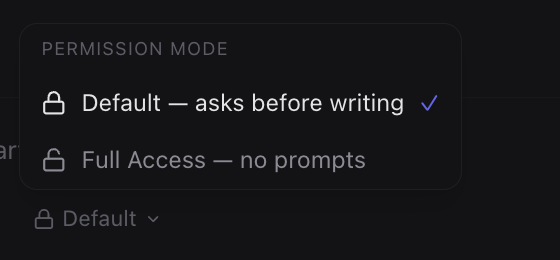
Permission Modes
Starfish has three approval modes, chosen with the approval selector in the Developer-mode composer toolbar. Simple mode always runs in Approve for me with a quiet, per-action safety check, so it has no selector.
Ask for approval (Recommended)
Every tool call that can create or modify data shows a permission prompt before executing. Destructive operations get a stronger, red confirmation. This is the safest option and is the default.
Approve for me
Reads and lookups run freely. Each operation that creates or modifies data is sent to a fast pre-execution safety reviewer, which answers allow, ask, or deny. If the reviewer is unsure, you get a prompt. Destructive operations are hard-blocked in this mode -- Starfish never runs them, even with your approval. Switch to Ask for approval if you need one to go through.
Full access
Read, create, and modify operations run with no prompt and no reviewer. Destructive operations are still hard-blocked, unclassifiable operations are still refused, and path guards and OS limits still apply.
WARNING
Full access lets the AI take actions without asking. Only enable it when you trust the current task and want maximum speed. You can switch back at any time.
Permission Levels
Red (Danger)
Destructive or irreversible operations. These include:
- Deleting files, records, or resources
- Overwriting existing data
- Sending messages on your behalf (email, chat)
- Modifying critical account settings
The prompt uses a red "Destructive Action — Cannot Be Undone" banner and has no "Always allow" option.
Amber (Caution)
Operations that create or change existing work. These include:
- Creating new files or records
- Editing data in a connected service
- Sending an email or message draft
The prompt uses an amber indicator for these operations.
What a Permission Prompt Shows
Each prompt displays:
- What it wants to do -- a plain-English description (e.g., "Save file", "Running command", "Calendar events list").
- Technical Details -- an expandable "Show details" section showing the exact command, file path, or API call. Hidden by default to keep the UI clean for non-technical users.
- Account affected -- which connected account the action touches.
- Can it be undone? -- whether the change is reversible.
- Information used -- what the action is based on.
- For send/draft tools, a preview of the actual message (recipient, subject, and body) so you review what goes out.
Accepting or Rejecting
- Allow -- the operation executes and the AI continues.
- Always allow -- grants this exact call (targets, count, recipients) for future turns. Available in Developer mode.
- Don't allow -- the operation is blocked. The AI is notified and adjusts its approach. In Developer mode you can add an optional reason the AI will see.
If a permission prompt is missed (e.g., during navigation), Starfish re-checks the server every 2 seconds to re-surface it. Sessions with pending permission prompts show an "Needs input" indicator in the sidebar.
Path Guards
Certain locations are always blocked, regardless of permissions or mode. The AI cannot read, write, or execute anything in:
~/.ssh,~/.aws,.gnupgdirectories/System/and/Applications/(application internals)- Shell commands that reference
node_modules - Credential and environment files --
.envfiles,id_rsa/id_ed25519,.npmrc,.netrc,.git-credentials,credentials.json,service-account*.json, and.pem/.key/.p12/.pfxfiles -- unless you turn on Allow reading credential and environment files in Settings → Local Access.
These guards operate at the path level -- the AI never even gets a permission prompt for these locations. The request is refused before it runs.
Read-Only Tools
Tools that cannot modify anything run without permission prompts in every mode:
- LS -- listing files
- Read -- reading file contents
- Glob -- searching file names
- Grep -- searching file contents
- WebSearch / WebFetch -- looking things up online
- Document, meeting, artifact, and timeline reads
These are safe by design and execute immediately.